A trusted platform connecting founders, investors and ecosystem partners to grow the next generation of Sierra Leonean businesses.




Makeni city, Northern-Sierra Leone
Freetown Sierra Leone
Kenema & Kailahun Town Sierra Leone

Freetown, Sierra Leone
No upcoming approved events
Explore completed community sessions or propose a new event.
Two-Sided Platform Value
Joining StartUp SL is free for startups and gives your venture a structured, investor-grade presence.
Access structured deal flow, compare ventures, and perform due diligence securely in one place.
Ecosystem Taxonomy
Knowledge & Publications
In this thought-provoking paper, Francis Stevens George, Founder and CEO of Innovation SL, explores why Africa needs a startup development model that reflects its unique market realities rather than simply replicating Silicon Valley approaches. Drawing lessons from China and Vietnam, the paper examines how strong market demand, customer needs, and economic momentum can drive startup success. It highlights a critical challenge facing many African startup ecosystems: accelerating businesses before validating whether their underlying problems are significant, marketable, and commercially viable. The paper introduces YAGBA (Your African Growth-Based Approach), a validation-first framework designed to assess problem strength, test real-world demand, and identify promising ventures before they advance to investment readiness and growth acceleration. Through its proposed three-stage pipeline—Diagnostic, Validation Lab, and Venture Readiness—YAGBA offers a different perspective on building stronger businesses, improving investor confidence, and creating more sustainable entrepreneurial ecosystems across Africa. Key takeaway: Africa's startup ecosystem must move beyond measuring success by the number of startups created and focus instead on validating real problems and building viable, sustainable companies.
Rethinking Innovation for Sierra Leone How do we turn the intelligence and creativity already present in our society into sustained improvements in living standards? This question sits at the heart of my paper, From Invention to Shared Prosperity. It revisits ideas I began developing in 2002, drawing on my experience building Innovation SL and teaching Entrepreneurship, Innovation and Creativity at Fourah Bay College, where I have been a guest lecturer since 2023. My central argument is simple: developing countries need the capacity to understand, adapt, improve and govern the technologies they use. Access to technology creates an opportunity. What we can do with it determines its value. The history of innovation helps explain why. From Africa’s traditions of technical knowledge to electric lighting and the internet, progress has depended on people combining ideas with skills, institutions and practical organisation. The invention is often the most visible part of the story. Making it reliable, affordable and widely useful requires further work. For Sierra Leone, that distinction matters. A machine needs operators, maintenance, power and a productive workload. A digital platform needs users, trust and a viable service model. A promising prototype needs a route into everyday use. Innovation becomes meaningful when these connections work. An enterprise that significantly improves its production process, reduces waste or consistently meets a buyer’s quality requirements can be innovating, even when the underlying technology already exists elsewhere. We should recognise the value of these improvements alongside more ambitious scientific and technological breakthroughs. Which innovation models can help us achieve this? My paper argues for a combination suited to the problem. Research can introduce new possibilities. Market demand can establish relevance. Testing and feedback can improve design. A systems approach can reveal missing connections between enterprises, universities, finance, standards and public services. Open innovation is particularly important because useful knowledge is distributed across these organisations, and among communities, technicians, customers and the diaspora. A university may understand the science. An operator may know why equipment fails in practice. A local fabricator may understand which materials and parts are available. A buyer may know the quality standards that determine whether the product sells. Bringing this knowledge together can make a solution workable. This is why I encourage my students to embrace open innovation: investigate what already exists, identify who knows something useful, collaborate and test assumptions. These habits help turn creativity into informed action. Such collaboration needs fair terms. Participants should understand how their contributions will be recognised, what they can use and how benefits will be shared. Its lasting value should include stronger local capability. Place-based innovation adds another essential dimension. A programme should reflect the assets, needs and operating conditions of the community, district or productive corridor it serves. The same equipment or training package may produce very different results in two locations because energy, transport, repair skills, markets and relationships differ. Local participants should help define the problem and assess the response, while remaining connected to expertise elsewhere. This gives national ambition a practical local foundation. These ideas also connect to Kizuki, the framework I first developed in 2002, linking education, information literacy and creative entrepreneurship with employment, income and living standards. Revisiting it today, I place greater emphasis on the conditions required between each stage. Education needs opportunities for application. Enterprises need demand and functioning support. Collaboration needs to leave people better able to solve the next problem. Artificial intelligence brings new possibilities to this discussion. It can help students and enterprises explore ideas, understand technical information and develop early prototypes. But generating a convincing answer does not establish that it is correct. An AI-written business plan cannot demonstrate that customers exist. As experimentation becomes easier, judgement becomes even more valuable: knowing which problem matters, what evidence is needed and whether a proposed solution works under local conditions. Ultimately, I believe we should judge innovation by what survives the pilot. Can people continue using the solution? Can they maintain and improve it? Has it strengthened productivity, service quality or livelihoods? Are its benefits reaching people who were previously excluded? These questions have implications for how we fund innovation, teach entrepreneurship and build support institutions. They direct attention towards continued use, demonstrated competence and sustained improvements. Sierra Leone’s innovation ambition should include original invention, practical adaptation and the ability to learn together. Our task is to build the relationships and capabilities through which knowledge becomes useful, and its benefits become more widely shared. I explore the historical background, innovation models and practical implications in the full paper: From Invention to Shared Prosperity: Innovation Models for Developing Countries in the Age of Open Innovation and Artificial Intelligence.
Make something people want’ is one of the most powerful instructions in startup history. But before founders build the ‘something’, they need disciplined evidence about the ‘people’ and the ‘want’. That is the space YAGBA is designed to occupy.
Africa does not suffer from a shortage of ideas. It suffers from a shortage of ventures built on problems that are sufficiently urgent, frequent, costly and commercially relevant to sustain a business.
Many Sierra Leonean Startups Are Not Yet Ready for Angel Investment, Let Alone Venture Capital
To rigorously validate YAGBA using African cases, it was useful to select cases that fall into the three validation categories: 1. Successful startups with strong problem definition 2. Failed startups with weak problem definition 3. Failed or struggling startups that appeared to have strong problems
About StartUp SL · Owned by Innovation SL
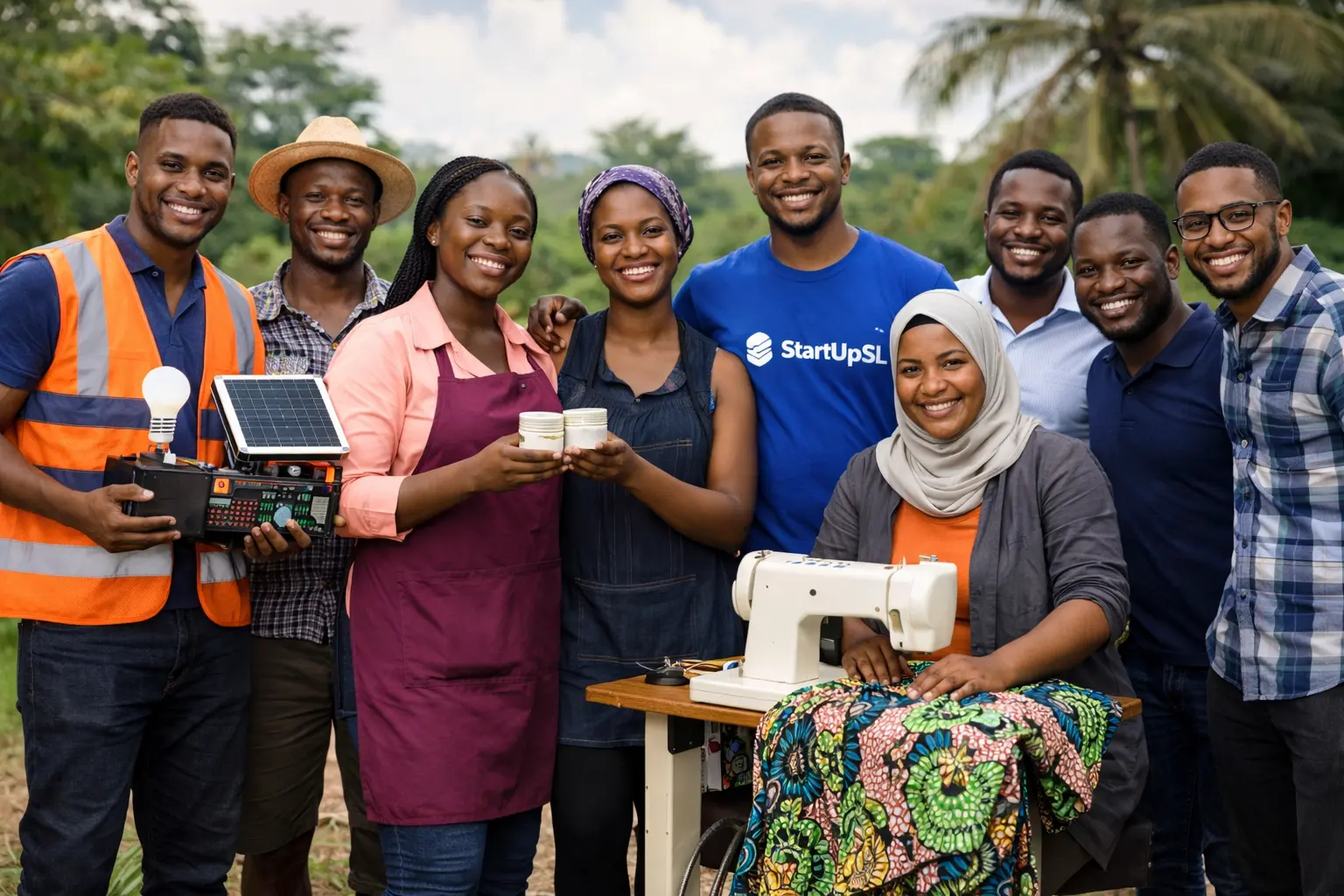
StartUp SL is owned by Innovation SL — a dedicated ecosystem platform connecting funders and investors with startups to build a vibrant economy. We provide a central hub where entrepreneurs, investors, mentors, and strategic resources unite to accelerate business success.
